AI is no longer a sci-fi novelty — it’s woven into the apps millions of Americans open every day. From voice assistants that answer questions while you cook, to recommendation engines that shape what you watch and listen to, AI quietly powers user experiences across shopping, communication, entertainment, productivity, and health. This article explains which AI-powered apps Americans use daily, how those apps use AI, the research behind the tech, and practical tips for using them safely and effectively.
Quick overview — what you’ll find here
- Listicle: the top AI-powered apps Americans use daily (with what their AI actually does)
- Deep dives: how recommendation engines, voice assistants, and chatbots work (with university research)
- A comparative table of app categories, use cases, and tips
- Actionable advice for safer, smarter use of AI apps
- FAQs people actually search for
The most-used AI-powered apps Americans open every day (listicle)
Below are the categories and representative apps that Americans commonly use daily. Each entry explains the AI feature that matters to users.
1. Conversational AI / Chatbots — ChatGPT, Google Gemini, Microsoft Copilot
What it does: answers questions, drafts messages, helps with brainstorming, coding, study help, and more.
Why it’s used daily: people use these tools for quick research, drafting emails, generating ideas, and as on-demand assistants. ChatGPT led AI app downloads in 2024 and remains among the most-downloaded and most-used AI apps. Sensor Tower+1
2. Voice Assistants — Siri, Google Assistant, Amazon Alexa
What it does: voice search, hands-free controls, smart-home commands, reminders, navigation.
Why it’s used daily: voice assistants are built into phones and smart speakers; millions rely on them for hands-free convenience. Recent estimates show high U.S. adoption for voice assistants (tens of millions of users per assistant). DemandSage+1
3. Productivity AI — Grammarly, Microsoft Editor, Notion AI
What it does: grammar/spell checking, tone and clarity suggestions, automated summarization, and writing assistance.
Why it’s used daily: many workers and students use these tools to speed writing, polish messages, or shorten long texts. Grammarly reports tens of millions of users and wide corporate adoption. Embryo+1
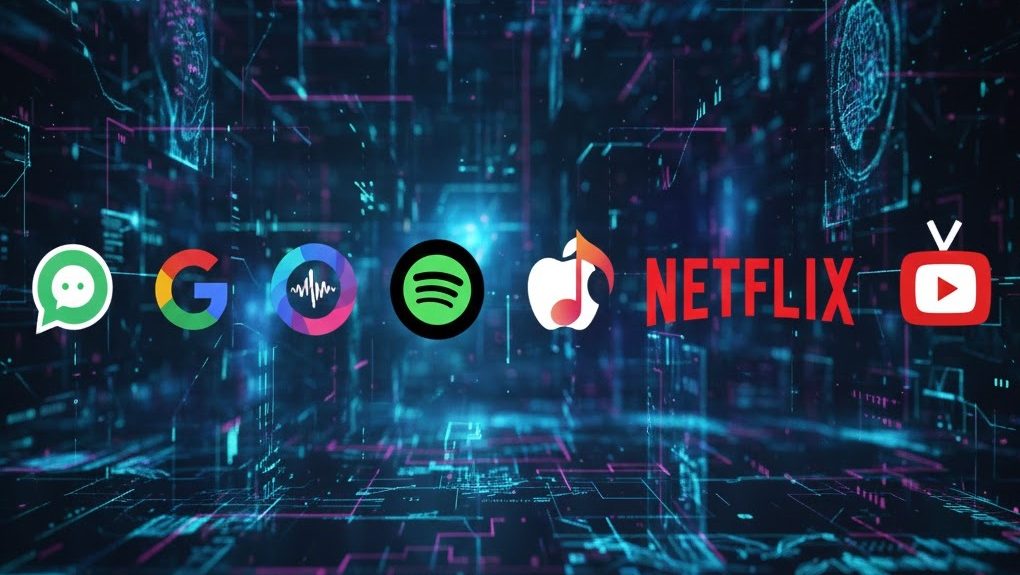
4. Music & Media Recommendation — Spotify, Apple Music, Netflix, YouTube
What it does: personalized playlists, “Discover Weekly,” autoplay queues, and show/movie recommendations based on listening/viewing history.
Why it’s used daily: recommendation engines increase engagement and make discovery effortless. Academic and industry research confirms the central role of recommender systems in user retention. arXiv+1
5. Social Media & Short-form Feeds — TikTok, Instagram, X (formerly Twitter)
What it does: algorithmically sorted feeds that prioritize engagement signals (watch time, likes, comments) and surface content tailored to you.
Why it’s used daily: hyper-personalized feeds are addictive; users keep returning because the algorithm learns their preferences quickly. Industry analyses and press coverage document how these recommender algorithms shape attention and behaviors. Financial Times
6. Navigation & Local Services — Google Maps, Waze, DoorDash, Uber
What it does: route optimization, ETAs, demand forecasting, delivery routing, and local recommendations.
Why it’s used daily: apps use real-time data and machine learning for faster travel, more accurate ETAs, and optimized logistics. Google Maps and Waze are staples for commuters and drivers. (See voice assistant and mapping adoption stats above.) DemandSage
7. Photo & Video Editing — FaceTune, Lensa, Adobe Photoshop/Express (AI features)
What it does: AI-based background removal, upscaling, retouching, and automated style filters.
Why it’s used daily: creators and casual users apply AI tools to polish visuals quickly for social sharing.
8. E-commerce & Shopping AI — Amazon (personalized recommendations), Shopify apps (product recommendations)
What it does: product suggestions, dynamic pricing, fraud detection, chat assistants for customer service.
Why it’s used daily: recommendation widgets and “frequently bought together” modules increase conversion and are omnipresent on retail platforms.
9. Health & Wellness Apps — sleep tracking, mental-health chatbots, fitness apps with personalization (e.g., Calm, Headspace, Fitbit highlights)
What it does: personalized sleep coaching, behavior nudges, conversational CBT tools, and workout plans optimized to your data.
Why it’s used daily: users rely on these apps for habits — many apps use ML personalization to tailor plans and notifications.
How these AI systems actually work (short explainers with university research)
Recommender systems: why Netflix and Spotify know what you might like
Recommender systems combine collaborative filtering (what users like you enjoyed), content-based signals (features of songs, movies, or products), and hybrid approaches. Netflix’s famous recommender system uses a mix of algorithms to predict what will keep users engaged — and it’s a major driver of viewing time. The Netflix recommender was the subject of deep research and is considered foundational in the field. Similarly, Spotify uses deep-learning approaches to balance exploration (new artists) and exploitation (known favorites) for playlists like Discover Weekly. ACM Digital Library+1
University-level work often advances these systems: computer science departments regularly publish papers improving collaborative filtering, sequence models, and content embedding techniques that platforms later adopt or adapt.
Conversational AI: language models and the rise of on-demand helpers
Large language models (LLMs) like those behind ChatGPT and Google Gemini are trained on massive text corpora and fine-tuned to follow instructions. They predict the next token in text, which—at scale—produces fluent conversation, summarization, translation, and code help. Research labs at universities (and industry R&D) study safety, prompt engineering, and evaluation metrics to improve helpfulness and reduce hallucinations. Sensor Tower and app-market analyses show massive downloads and engagement for chat apps, confirming their integration into daily life. Sensor Tower+1
Voice assistants: speech recognition + NLU + action orchestration
Voice assistants combine automatic speech recognition (ASR), natural language understanding (NLU), and dialog managers to interpret intent and act (e.g., set a timer, play music). Universities like Stanford and MIT publish research improving ASR robustness in noisy environments and dialect diversity — research that directly improves assistant performance in the wild. Adoption stats show tens of millions of U.S. users depend on voice assistants daily. DemandSage+1
Table: App category, daily use case, AI feature, and a quick tip
| Category | Daily Use Case | Core AI Feature | Pro tip |
|---|---|---|---|
| Conversational AI | Drafting email, learning, coding | LLMs, prompt following | Give clear prompts and iterate (short + specific) |
| Voice Assistant | Hands-free search, timers | ASR + NLU | Use full commands (e.g., “Set a 20-minute timer for rice”) |
| Productivity | Email/tone checking | ML-based grammar & tone | Review suggestions — AI is a helper, not final authority |
| Music/Video | Discovering songs, bingeing shows | Recommender systems | Create fresh listening history to “teach” the algorithm |
| Social Media | Scrolling personalized feed | Engagement-driven ranking | Curate your feed: mute/see less for better recommendations |
| Maps/Transport | Navigation, delivery tracking | Route optimization | Share ETA to trusted contacts for safety |
| Photo/Video Edit | Rapid social posts | Image synthesis & enhancement | Keep ethical edits clear (e.g., disclaimers for manipulated images) |
| E-commerce | Product discovery | Personalization + fraud detection | Check multiple reviews and price history |
| Health & Wellness | Sleep & mood tracking | Behavioral personalization | Protect sensitive health data — check privacy settings |
Actionable advice: use AI apps responsibly and get better results
- Be explicit with prompts and inputs. Short or vague prompts yield weaker outputs. For chatbots, frame exact tasks (e.g., “Draft a 150-word LinkedIn post about X with a professional tone”).
- Understand privacy & data sharing. Many AI apps collect usage data to improve models. Review settings and permissions (especially for health, financial, or home-device data).
- Use AI as augmentation, not autopilot. Tools like Grammarly and Copilot are time-savers — but always review suggested edits for accuracy and tone.
- Teach recommenders intentionally. Actively save, like, or hide content to refine your feed.
- Guard against hallucinations. LLMs can invent facts. Verify important information (medical, legal, financial) through trusted sources.
- Check model provenance when accuracy matters. Some apps state the model/version used; others don’t. If accuracy matters (e.g., coding or research), prefer sources that disclose model details.
- Limit app permissions you don’t need. For example, disable microphone or location access if unused.
- Diversify discovery channels. Don’t rely solely on one app’s recommender for news or product discovery — algorithmic echo chambers can narrow perspectives.
University and research explanations that matter to users
- Netflix / Recommender research (ACM): Netflix’s recommender system is central to user engagement and is a widely cited engineering case study. The algorithms balance personalization and novelty to optimize watch time. This research underpins how entertainment platforms influence what Americans watch nightly. ACM Digital Library
- Spotify recommendations (academic studies): Deep-learning and hybrid approaches—combining audio features with user behavior—are shown to drive discovery and retention on music platforms. University and independent papers explore architectures that personalization engines use to make “perfect” playlists. arXiv
- Voice assistant adoption & UX research: Studies from human-computer interaction (HCI) labs show that ASR accuracy and natural language understanding directly influence adoption; improvements from academic labs lead to better real-world performance in noisy or multi-accent contexts. Large-scale usage stats confirm voice assistants are now part of daily routines for tens of millions in the U.S. DemandSage+1
- Human behavior & attention (Generative AI context): Analyses in major outlets and academic circles point out how generative AI and algorithmic feeds can alter attention and productivity; responsible design and active user curation reduce negative outcomes. Financial Times
Case studies — real daily examples (short vignettes)
A. The commuting parent
Mornings: “Hey Siri, add milk to my list.” Commute: Google Maps reroutes around an accident. Work: Grammarly polishes an urgent email. Evening: Spotify’s “Daily Mix” finds a playlist that helps unwind. Each touchpoint is AI smoothing small frictions in day-to-day life. (Voice assistant + maps + productivity + recommender.) DemandSage+1
B. The creator
A content creator records video on their phone, uses an app with AI upscaling and background removal, schedules posts with AI caption suggestions, and relies on platform analytics to optimize posting times. AI reduces production costs and speeds iteration.
C. The shopper
An online shopper gets product recommendations (AI), reads seller responses drafted with a chatbot assistant, and uses a delivery tracker that optimizes the final-mile route (AI logistics).
Table: How often Americans use AI features (approximate patterns and reasoning)
| AI Feature | Daily Use Pattern | Why it matters |
|---|---|---|
| Voice commands | Morning & evening routines; hands-free tasks | Increases safety (driving), convenience |
| Recommenders | Content discovery throughout day | Drives entertainment and e-commerce spending |
| Chatbots | On-demand problem solving, drafting | Replaces quick web searches & manual drafting |
| Productivity suggestions | Work hours | Improves output quality and speed |
| Photo AI | Social posting times | Lowers barriers to content creation |
| Health personalization | Daily check-ins, sleep tracking | Supports behavioral change |
Sources: app download and usage analyses (Sensor Tower, app trackers), voice assistant adoption studies, and platform research on recommender importance. Sensor Tower+1
FAQs — What people are searching for right now
Q: Which AI apps are most popular in the U.S.?
A: Chatbots like ChatGPT, voice assistants (Siri, Google Assistant, Alexa), productivity tools (Grammarly, Microsoft Editor), and recommender-driven platforms (Spotify, Netflix, TikTok) are among the most popular by downloads and daily engagement. Industry app-market reports show ChatGPT at the top of AI app downloads in recent years. Sensor Tower+1
Q: Are voice assistants safe to use in terms of privacy?
A: Voice assistants collect audio and usage data to improve performance; many vendors allow you to review and delete recordings and adjust privacy settings. Review device settings and vendor privacy policies, and limit always-on mic access when possible. Statista
Q: Can I trust AI writing assistants with my confidential documents?
A: Use caution. Many productivity AIs send text to central servers for processing. For sensitive corporate or legal documents, prefer tools that offer enterprise privacy guarantees or on-premise models. Embryo
Q: Why does my feed seem repetitive or “addictive”?
A: Recommender systems prioritize engagement signals (watch time, clicks). This optimizes for retention but can create echo chambers or repetitive content. Actively hide content you don’t want to see and diversify discovery channels. Financial Times
Q: How do I avoid being misled by AI hallucinations?
A: Always verify facts produced by LLMs against credible sources, especially for health, legal, or financial information. Use AI outputs as starting points, not final answers. Resourcera